
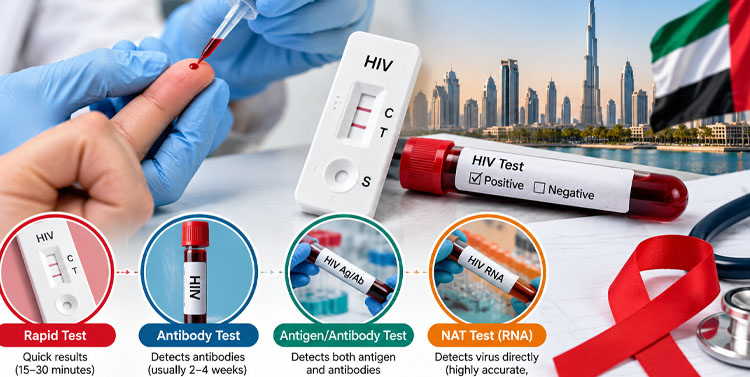
If you are considering an HIV test in UAE, it is important to understand that accuracy depends on more than the laboratory's testing equipment. The type of test, timing after a possible exposure, specimen used and diagnostic testing algorithm all influence how confidently a result can identify HIV infection.
Modern HIV tests are highly accurate when used correctly, but no test can detect HIV immediately after infection. The time between infection and reliable detection is known as the window period. Different tests detect different markers of infection, so their detection windows are not identical.
Antibody Tests Detect the Immune Response
Antibody tests look for antibodies produced by the immune system in response to HIV. They can be performed using different specimen types, including blood or oral fluid, depending on the test.
Their main limitation is timing. The body needs time to produce detectable levels of antibodies. According to the CDC, antibody tests can generally detect HIV about 23 to 90 days after infection. A negative result obtained too early can therefore be unreliable because the person may still be within the window period.
This does not mean antibody tests are inherently inaccurate. Their performance is highly useful once sufficient antibodies have developed. The key issue is whether testing occurred at an appropriate time.
Antigen and Antibody Tests Detect Infection Earlier
Laboratory antigen and antibody tests, often called fourth generation tests, look for both HIV antibodies and the p24 antigen. The p24 antigen can become detectable before the body has produced enough antibodies to be identified reliably.
For a laboratory antigen and antibody test using blood drawn from a vein, the CDC states that HIV infection can usually be detected 18 to 45 days after exposure. Finger prick antigen and antibody tests can have a longer detection window.
This makes laboratory fourth generation testing particularly useful when testing needs to identify relatively recent infection. However, a negative result during the relevant window period cannot be interpreted in isolation as definitive evidence that infection did not occur.
NAT Looks for HIV Genetic Material
A nucleic acid test (NAT) takes a different approach. Instead of looking for antibodies or p24 antigen, it detects HIV genetic material in the blood.
NAT can detect infection earlier than antibody or antigen and antibody testing. The CDC states that it can generally detect HIV 10 to 33 days after infection. Because of its cost and clinical role, NAT is not routinely used as the first screening test for everyone. It may be considered when recent high risk exposure or possible acute HIV infection requires earlier investigation.
The timing of NAT also matters. A negative result does not automatically eliminate the need for follow up testing when exposure was recent or clinical circumstances remain concerning.
Why One Test Should Not Determine an HIV Diagnosis
A major point that is often overlooked is the difference between a screening test and a confirmed diagnosis.
A reactive screening result does not mean that a person should immediately be considered HIV positive. Reactive results require an appropriate follow up testing process.
WHO recommends standardized HIV testing algorithms using combinations of quality assured assays because relying on an inappropriate testing sequence can increase the risk of misdiagnosis. Its current guidance recommends testing strategies designed to achieve at least 99% positive predictive value, with individual assays meeting specified sensitivity and specificity requirements.
This is why the accuracy of an HIV testing service depends not only on the analytical performance of an individual test but also on how the entire diagnostic algorithm is designed and implemented.
Why Timing Matters More Than a Headline Accuracy Figure
People often ask whether an HIV test is "99% accurate" or "100% accurate." Such statements can be misleading without considering when the test was performed.
A highly sensitive test performed during the window period may still fail to detect a recent infection because the biological marker it is designed to identify has not reached a detectable level.
The more useful question is therefore:
Which test was used, and how long after the possible exposure was it performed?
The answer can determine whether a negative result is reassuring or whether repeat testing is appropriate.
What Makes HIV Testing Reliable in the UAE?
For an HIV test in UAE, reliability depends on using an appropriate, quality assured test and following a validated diagnostic process. WHO emphasizes that countries need standardized testing strategies and quality assurance to minimize false reactive and false negative diagnoses.
A reputable testing facility should also provide appropriate follow up when a screening result is reactive rather than treating the initial result as a definitive diagnosis.
Accuracy Depends on the Right Test at the Right Time
Modern HIV testing is highly accurate, but accuracy cannot be separated from timing and test type.
Antibody tests detect the immune response, antigen and antibody tests can identify infection earlier, and NAT detects viral genetic material at an earlier stage. Each has a specific role, and none should be interpreted without considering the window period and clinical circumstances.
If you have had a possible HIV exposure, speak with a qualified healthcare professional about which test is appropriate and when it should be performed. Avoid relying on a single early negative result to make a definitive conclusion when testing occurred during the window period.
The most reliable HIV diagnosis comes from the right test, performed at the appropriate time and interpreted through a validated testing algorithm rather than from a test result viewed in isolation.

 UAE
UAE Ethiopia